
Dubai Property ROI vs London & Toronto 2026: A Global Real Estate Comparison
What You Should Know
Explore Top Real Estate Companies in Dubai Guide with practical insight into trusted companies, local market visibility, and how users compare real estate services before making decisions in Dubai.
- This guide focuses on Dubai Property ROI vs London & Toronto with UAE-specific context and practical decision support.
- Use this article to understand the topic faster before moving into related service pages and directory listings.
- The primary search topic for this article is Real Estate Companies in Dubai.
- Related internal links below help readers continue into higher-intent UAE business guides.
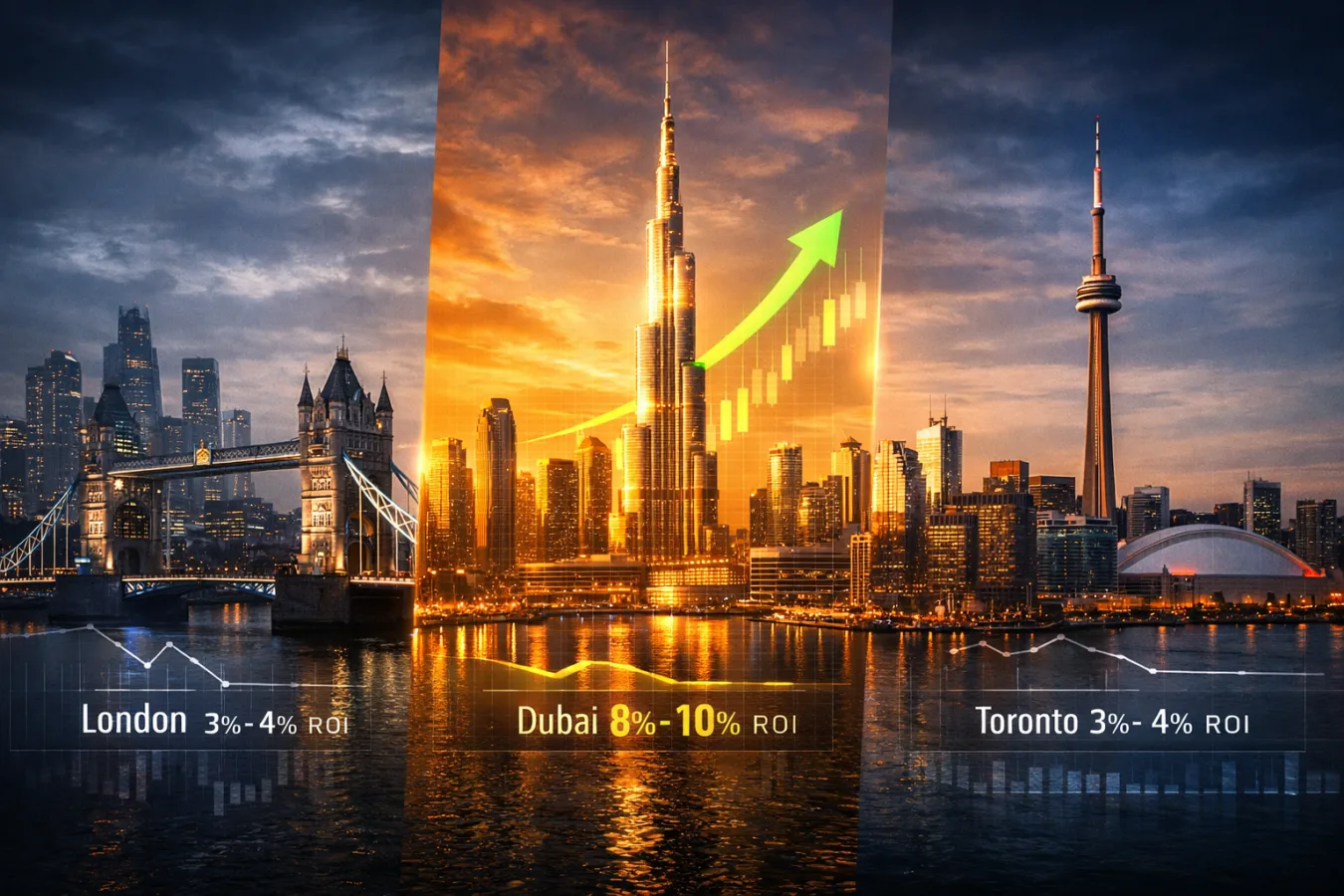
Dubai Property ROI vs. London & Toronto: A 2026 Comparison
In 2026, global capital is becoming increasingly selective. Investors are no longer satisfied with prestige addresses alone—they are demanding measurable returns, tax efficiency, currency stability, liquidity strength, and long-term economic visibility. The era of buying property purely for reputation has faded. Today’s investor is analytical, data-driven, and globally mobile.
High-net-worth individuals, institutional funds, and cross-border investors are now comparing markets based on net rental yield, post-tax profitability, regulatory stability, infrastructure investment, and macroeconomic growth forecasts. In this environment, traditional real estate strongholds are facing serious competition from emerging high-performance markets.
Among the most debated real estate comparisons this year is Dubai property ROI versus London and Toronto.
For decades, London symbolized generational wealth preservation. Toronto represented stable North American growth supported by immigration and economic resilience. Both cities built reputations as safe havens for capital during uncertain times.
While London and Toronto have long been considered secure real estate hubs, Dubai’s rapid infrastructure expansion, tax-neutral framework, and high rental yields have dramatically shifted investor attention.
This in-depth analysis evaluates rental performance, taxation structures, macroeconomic fundamentals, investor entry costs, and long-term forecasts to determine where property capital performs best in 2026.
Rental Yield Comparison: Dubai vs London vs Toronto (2026)
Rental yield remains the most immediate and transparent indicator of real estate investment performance. While capital appreciation may fluctuate based on macroeconomic cycles, rental income provides consistent cash flow and forms the backbone of buy-to-let strategies. For income-focused investors in 2026, yield compression has become the defining theme across mature Western markets.
In simple terms, rental yield measures the annual rental income generated by a property relative to its purchase price. However, serious investors distinguish between gross yield and net yield. Gross yield reflects total rental income before expenses, while net yield accounts for property taxes, maintenance costs, management fees, insurance, and income taxation.
This distinction is critical when comparing Dubai, London, and Toronto.
Dubai: High-Yield Performance in a Growth-Oriented Market
In 2026, Dubai continues to deliver some of the strongest rental yields among global gateway cities.
- Gross rental yields: 7% to 10%
- Net rental yields: 6% to 9%
These figures are driven by strong structural fundamentals:
- Expatriate Population Growth: A large expatriate population sustains rental demand.
- Corporate Relocations: Multinational companies establishing regional headquarters increase executive leasing demand.
- Short-Term Rental Market: Tourism and business travel support strong short-term rental performance.
- Favorable Price-to-Rent Ratio: Acquisition costs relative to rental income remain competitive compared to Western markets.
For example, a $500,000 apartment in prime Dubai districts may generate $35,000 to $45,000 annually, creating a significantly stronger cash-flow profile compared to similar capital deployed in London or Toronto.
London: Yield Compression in a Mature Financial Hub
- Gross rental yields: 3% to 5%
- Net rental yields: 2% to 4%
Yield compression in London is influenced by:
- High property acquisition costs
- Income tax up to 45% on rental profits
- Stamp duty reducing initial ROI
- Regulatory constraints on landlords
- Higher maintenance costs for older properties
London continues to serve as a wealth preservation market rather than a high-cash-flow investment environment.
Toronto: Stability with Limited Yield Expansion
- Gross rental yields: 3% to 4%
- Net rental yields: 2% to 3%
Toronto’s rental yield limitations are shaped by:
- High purchase prices relative to rental income
- Land transfer taxes
- Income taxation on rental profits
- Strict short-term rental regulations
- Sensitivity to interest rate cycles
While vacancy rates remain stable due to immigration-driven demand, yield performance remains comparatively modest.
Yield Compression vs Yield Expansion
Yield compression occurs when property prices rise faster than rental income growth. This pattern is evident in both London and Toronto. Dubai, however, remains in a relative yield expansion phase, where rental demand growth continues to support strong yield ratios.
Comparative Yield Table (2026)
| City | Gross Yield | Net Yield | Tax Impact | Rental Flexibility |
|---|---|---|---|---|
| Dubai | 7%–10% | 6%–9% | Minimal | High |
| London | 3%–5% | 2%–4% | High | Moderate |
| Toronto | 3%–4% | 2%–3% | Moderate | Limited |
Investor Scenario: $1 Million Allocation
- Dubai: $70,000–$90,000 annual gross rental income
- London: $30,000–$45,000 annual gross rental income
- Toronto: $30,000–$40,000 annual gross rental income
Over a 10-year investment horizon, the compounding impact of higher annual rental income becomes substantial.
From a pure rental yield perspective, Dubai significantly outperforms London and Toronto in 2026. Its tax-neutral structure, strong tenant demand, and flexible rental ecosystem create superior net cash-flow potential.
London and Toronto remain institutionally stable markets; however, yield compression limits their immediate income generation compared to Dubai’s high-yield model.
SPONSORED CONTENT
Taxation Framework Comparison
Dubai (UAE)
- 0% Personal Income Tax
- No Capital Gains Tax
- No Annual Property Tax
- 4% One-time Transfer Fee
London (UK)
- Up to 45% Income Tax on rental profits
- Capital Gains Tax up to 28%
- Stamp Duty up to 12%
- Annual Council Tax
Toronto (Canada)
- Federal & Provincial Income Tax
- Capital Gains Tax on sale
- Land Transfer Tax
- Property Tax annually
From a net profitability standpoint, Dubai’s tax-neutral structure significantly enhances real ROI compared to London and Toronto.
Capital Appreciation Trends (2026–2030 Forecast)
Capital growth potential is influenced by infrastructure expansion, migration patterns, economic growth, and regulatory stability.
| City | 2026 Growth Estimate | 2027–2030 Outlook |
|---|---|---|
| Dubai | 5% – 8% | Strong (Driven by D33 Economic Agenda) |
| London | 2% – 4% | Moderate Recovery |
| Toronto | 2% – 3% | Stabilization Phase |
Dubai’s urban master-planned communities such as Dubai Islands and Creek Harbour continue attracting institutional and foreign capital.
Currency Stability Analysis
The UAE Dirham (AED) remains pegged to the US Dollar, providing currency predictability. In contrast:
- GBP experiences inflation-driven fluctuations.
- CAD responds to commodity cycles and interest rate shifts.
For international investors, currency stability enhances portfolio risk management.
Investor Entry Cost Comparison
| City | Average 1-Bedroom Prime Area | Residency Benefits |
|---|---|---|
| Dubai | $450,000 – $600,000 | Golden Visa (10-year residency) |
| London | $700,000+ | No automatic residency |
| Toronto | $650,000+ | No residency linked |
Macroeconomic Drivers
- Dubai: Population growth, global talent inflow, D33 expansion plan.
- London: Post-Brexit economic recalibration.
- Toronto: Immigration-driven housing demand.
Risk Analysis
- Dubai: Market cyclicality risk.
- London: Taxation and regulatory tightening.
- Toronto: Housing affordability pressure.
Psychological Investment Behavior
Investors historically gravitate toward familiarity. However, data-driven capital increasingly prioritizes yield efficiency over legacy prestige. Dubai’s narrative of growth and modern infrastructure appeals to forward-looking investors.
FAQ Section
Is Dubai property a better investment than London in 2026?
In 2026, Dubai property generally offers higher rental yields and stronger post-tax returns compared to London. While London remains a globally respected and stable real estate market, average gross yields in central areas range between 3% and 5%, with net yields often falling to 2%–4% after income tax and operational expenses.
Dubai, by contrast, delivers gross yields between 7% and 10% in many established residential districts, with minimal taxation on rental income and no capital gains tax. For income-focused investors prioritizing cash flow and net profitability, Dubai currently presents a structurally stronger ROI profile. However, London may still appeal to investors seeking long-term capital preservation and institutional stability.
What is the average rental yield in Toronto in 2026?
In 2026, Toronto’s average gross rental yield ranges between 3% and 4%, depending on property type and location. Condominiums in central districts tend to fall within this range, while suburban properties may produce slightly higher yields. After accounting for federal and provincial income taxes, property taxes, maintenance, and management costs, net yields typically fall to 2%–3%.
Toronto’s market is supported by strong immigration-driven demand, but high acquisition costs relative to rental income continue to compress overall yield performance compared to emerging high-yield markets like Dubai.
Does Dubai charge capital gains tax?
No, Dubai does not levy capital gains tax on property sales. Investors who sell real estate assets in Dubai are not subject to capital gains taxation under current UAE regulations. This significantly enhances long-term net profitability, especially for investors targeting appreciation over a 5–10 year horizon.
By contrast, London and Toronto impose capital gains tax upon sale, reducing realized returns. This tax efficiency is one of the primary structural advantages that makes Dubai attractive to international property investors.
Is London property still safe for long-term investment?
Yes, London remains one of the world’s most established and institutionally secure property markets. It benefits from a transparent legal framework, deep liquidity, global financial integration, and strong long-term demand driven by international capital.
However, while London offers stability and wealth preservation characteristics, its rental yields are relatively compressed, and taxation levels are higher than in Dubai. For investors prioritizing steady long-term growth and asset security over high cash flow, London remains viable — but it may not provide the strongest short-to-medium term ROI compared to Dubai in 2026.
Can foreigners buy property in Dubai?
Yes, foreigners can buy freehold property in designated areas of Dubai. The UAE government permits international investors to own property outright in specific freehold zones, including popular districts such as Dubai Marina, Downtown Dubai, Palm Jumeirah, Dubai Creek Harbour, and Jumeirah Village Circle.
Additionally, property investment above a specified threshold (currently AED 2 million) may qualify investors for the UAE Golden Visa, providing long-term residency benefits. This combination of ownership rights and residency incentives strengthens Dubai’s appeal to global investors.
What are the biggest risks in Dubai real estate?
Like all property markets, Dubai carries certain investment risks. The primary risks include market cyclicality, potential oversupply during rapid development phases, and sensitivity to global economic conditions. Historically, Dubai has experienced price corrections following rapid growth cycles.
However, regulatory reforms, improved escrow protections, and demand diversification have strengthened market resilience compared to previous cycles. Investors can mitigate risks by focusing on established communities, quality developers, and long-term holding strategies.
How does currency affect ROI?
Currency plays a critical role in cross-border real estate investment. Dubai’s currency, the UAE Dirham (AED), is pegged to the US Dollar, offering relative exchange-rate stability. This reduces currency volatility risk for investors operating in USD or USD-linked economies.
In contrast, the British Pound (GBP) and Canadian Dollar (CAD) fluctuate based on inflation, interest rate policy, and economic cycles. For international investors, currency depreciation or appreciation can significantly impact real net returns when converting rental income or capital gains back into their home currency.
Which city offers residency benefits?
Dubai offers the most direct residency benefit linked to property investment. Investors who meet the minimum investment threshold can qualify for a 10-year renewable Golden Visa, allowing residency for themselves and eligible family members.
Neither London nor Toronto automatically grant residency through residential property purchase alone. While both countries have separate immigration pathways, real estate ownership does not directly provide residency status. This distinction gives Dubai a unique strategic advantage for globally mobile investors seeking both asset performance and geographic diversification.
Conclusion: Where Should Investors Allocate in 2026?
In 2026, real estate capital allocation is increasingly performance-driven. Dubai’s combination of high rental yields, zero personal income tax, absence of capital gains tax, residency incentives, infrastructure expansion under the D33 economic vision, and currency stability positions it as a compelling alternative to traditional Western markets.
London and Toronto remain globally respected and institutionally secure property markets, offering long-term stability and liquidity. However, their compressed rental yields and heavier taxation structures reduce net profitability relative to Dubai’s high-yield model.
For investors prioritizing cash flow, tax efficiency, and growth-oriented positioning through 2030, Dubai currently offers measurable financial advantages. Portfolio diversification strategies may still include London or Toronto for stability, but Dubai stands out in 2026 as a performance-optimized real estate destination.
London and Toronto remain globally respected markets but offer compressed yields and heavier taxation.
For investors seeking performance-driven allocation in 2026, Dubai presents measurable financial advantages.
Related UAE business research
Continue your research with these related UAE pages for stronger comparison, local discovery, and practical business planning.
Continue Your Research
Use these related UAE business pages to move from reading into deeper comparison, local discovery, and higher-intent business research.
